


At the Core: the Warsaw Gradient of Urbanisation
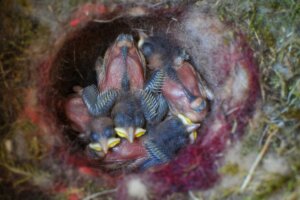
Warsaw is our living laboratory — and the Warsaw Gradient of Urbanisation is at the heart of our research. Since 2016, we have followed populations of great tits (Parus major) and blue tits (Cyanistes caeruleus) across a mosaic of environments, from natural and suburban habitats to some of the most intensely urbanised parts of the city. Around 500 nestboxes across eight study sites provide the backbone for long-term, individual-based research into how wildlife responds to urbanisation. Importantly, we do not see urbanisation simply as “urban versus rural”. Cities are complex and heterogeneous landscapes, shaped by interacting gradients of vegetation, impervious surfaces, pollution, light, noise, temperature and human activity. Capturing this complexity — and measuring animals within the environments they actually experience — is fundamental to understanding ecological and evolutionary processes. Our long-term data reveal just how powerful these effects can be: increasing impervious surface around a nest from 0 to 50% is associated with roughly halving reproductive output in both great tits and blue tits. Such quantitative insights are increasingly important for conservation biology, helping us identify how urban landscapes can better support wildlife as the pressures of urbanisation interact with a rapidly changing climate.
There is no substitute for collecting data on the ground. Long-term field studies provide the biological reality on which larger syntheses, meta-analyses and mega-analyses ultimately depend. Our work also helps strengthen the representation of Central and Eastern Europe in urban evolutionary ecology, bringing data from a region with its own distinctive historical, social and economic trajectories. What began as a National Science Centre-funded project in ecological genetics has grown into the scientific backbone of the Anthropocene Biology Lab, generating questions across ecology, evolutionary biology, behaviour, conservation, toxicology and molecular biology. The Warsaw Gradient allows us both to zoom in — following individuals, populations and environments through time — and to zoom out, connecting those observations to broader patterns of how life is responding to urbanisation across the planet.
Selected publications on the topic:
2025
Continental patterns of phenotypic variation along replicated urban gradients: a mega‐analysis Journal Article
In: Ecology Letters, vol. 28, iss. 7, pp. e70180, 2025.
Concrete habitat severely decreases the reproductive output of two urban birds Journal Article
In: Conservation Letters, vol. 18, iss. 2, pp. e13093, 2025.
2020
Urban evolutionary biology Book
Oxford University Press, 2020.